Alloy Steel Pipe Fittings Manufacturer in India
ASTM A234 WP11 & WP22 Alloy Steel Fittings: Practical Material, Dimension, Application and Procurement Guide by Arrow Piping
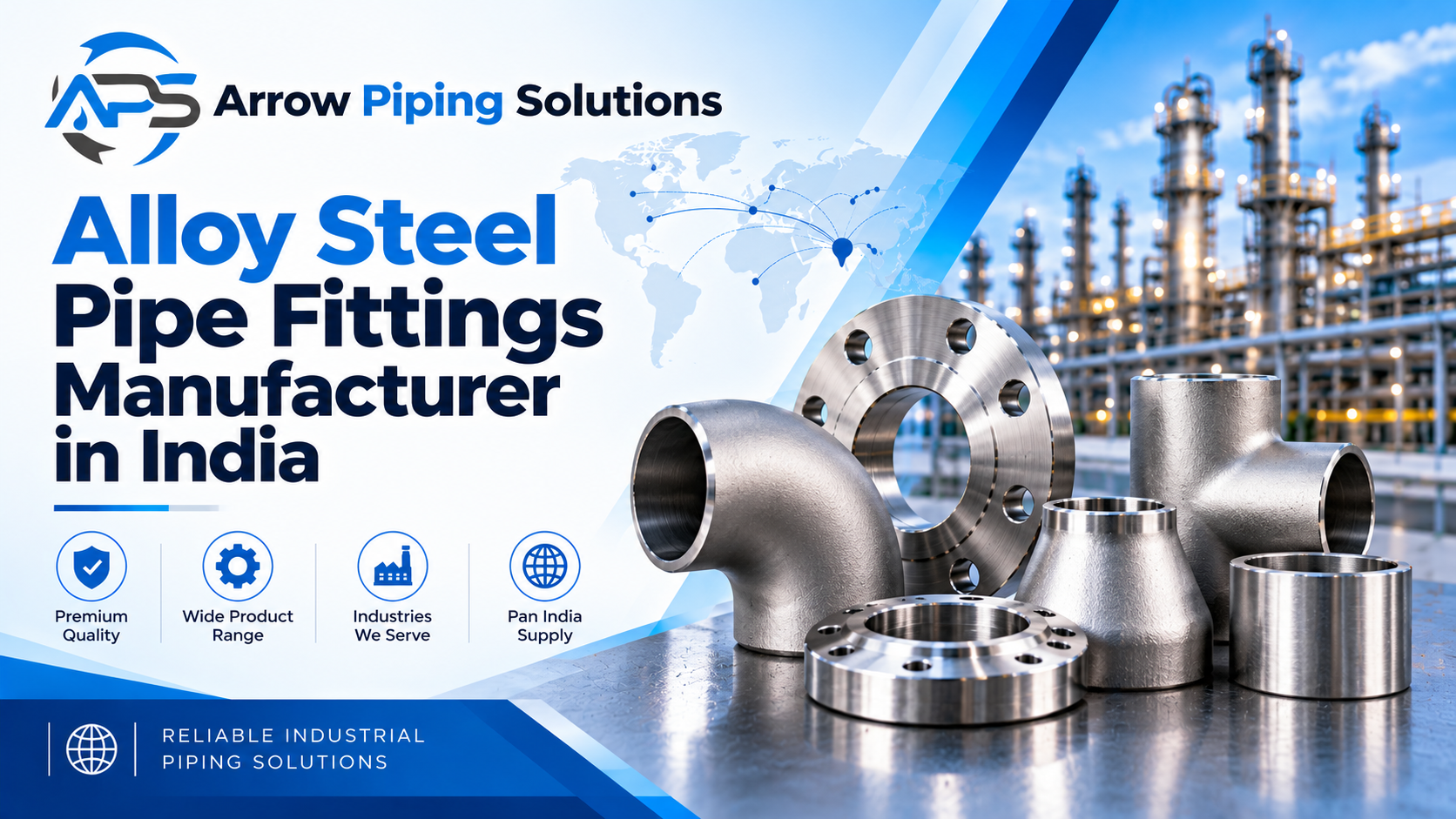
Alloy steel pipe fittings selection guide: elbows, tees, reducers, caps and the grades used in elevated-temperature process piping. Illustrative image; replace with a product-specific photograph before publishing.
Searching for an Alloy Steel Pipe Fittings Manufacturer in India usually starts with a grade and a size. But a workable purchase order needs more: wall thickness, end preparation, heat treatment, inspection scope and the design code behind the line. Missing one of those details can turn an apparently straightforward order into a site-fit problem.
Arrow Piping is the company featured in this guide. Below, we explain how common alloy steel fittings are specified and what industrial buyers should check before asking for a quotation. Product availability and any manufacturing or testing scope should be confirmed directly with the sales team.
1. What Are Alloy Steel Pipe Fittings?
Alloy steel pipe fittings are piping components made from steel with specified alloy additions—often chromium and molybdenum in high-temperature service. Elbows redirect flow, tees create branches, reducers connect different nominal sizes and caps close an end. The required grade comes from the operating conditions and design rules, not just the visual shape of the fitting.
Quick answer: For a typical chrome-moly buttweld fitting enquiry, confirm an ASTM A234 grade such as WP11 or WP22 and dimensional requirements such as ASME B16.9. Those references solve different parts of the specification.
2. Standards Buyers Need to Distinguish
A frequent purchasing mistake is treating a material standard and a dimensional standard as the same thing. They are not. Check which documents govern the actual component.
| Reference | What It Covers |
|---|---|
| ASTM A234 / ASME SA-234 | Material requirements for wrought carbon and alloy steel fittings for moderate and elevated-temperature service; specify the actual grade. |
| ASME B16.9 | Dimensions, tolerances, ratings, testing and marking for factory-made wrought buttwelding fittings. |
| ASME B16.11 | Dimensions, ratings and requirements for forged socket-weld and threaded fittings. |
| ASTM A182 | Forged or rolled alloy and stainless steel piping components, relevant when the specified fitting form calls for it. |
| ASME B36.10M | Pipe dimensions and schedules used as a reference when matching fitting ends to the adjoining pipe. |
| ASME B31.3 | Process piping design and construction code, where specified by the project. |
| Project inspection documents | Material test reports, traceability and any additional examinations agreed in the purchase order. |
3. Common Chromium-Molybdenum Grades
ASTM A234 covers more than one alloy steel grade. WP11 and WP22 are often discussed for industrial steam and process piping, but their suitability must be assessed against the line specification. Do not approve a grade substitution from a short product description.
| Grade / Designation | Typical Selection Conversation | Verification Before Order |
|---|---|---|
| ASTM A234 WP11 | Chromium-molybdenum alloy steel commonly evaluated for elevated-temperature piping. | Confirm grade/class where applicable, heat treatment, weldability and permissible design conditions. |
| ASTM A234 WP22 | Chromium-molybdenum alloy steel with a different alloy balance from WP11. | Check the piping material class and qualified welding requirements; do not assume interchangeability. |
| ASTM A234 WP5 / WP9 | Additional chromium-alloy grades used where specific service requirements call for them. | Confirm project approval, material and welding documentation. |
| ASTM A234 WP91 | Specialized high-temperature material with stricter fabrication and heat-treatment considerations. | Require engineering review of approved material, heat treatment and welding/PWHT requirements. |
4. Chemistry: What Actually Matters?
Chromium and molybdenum can influence oxidation behaviour and elevated-temperature properties. Their proportions differ by grade; that does not make one grade universally better. The engineering review also considers strength, toughness, fabrication history and welding procedures.
| Material Factor | Why Buyers Should Check It | Practical Procurement Check |
|---|---|---|
| Chromium (Cr) | An important alloy addition in many heat-resistant steels. | Verify grade chemistry against the ordered specification. |
| Molybdenum (Mo) | Contributes to performance considerations in certain elevated-temperature alloys. | Check material test report values and grade designation. |
| Carbon (C) | Influences hardenability and welding response. | Review chemistry and the approved weld procedure, if relevant. |
| Heat treatment | Material properties can depend on the specified thermal condition. | Ask for the documented heat-treatment condition required by the specification. |
| Heat identification | Connects a supplied fitting to its inspection record. | Ensure markings and material documents can be reconciled. |
5. Mechanical Properties and Inspection Documents
Do not copy a single tensile-strength or hardness number into every alloy-steel enquiry. Requirements vary by grade, class where applicable, product specification and edition. The correct acceptance values come from the agreed standards and material test documentation.
| Item | What to Review | Avoid This Mistake |
|---|---|---|
| Tensile / yield properties | Results or compliance statements for the specified grade and applicable test requirements. | Using another grade’s minimum values. |
| Hardness | Limits and readings when required by material specification or project. | Assuming every fitting needs the same hardness limit. |
| Impact testing | Whether the temperature/service or project requires impact qualification. | Assuming elevated-temperature grades automatically satisfy low-temperature needs. |
| Non-destructive examination | Method, coverage, acceptance criteria and report requirements when ordered. | Treating optional UT, RT or MPI as universally included. |
| Material traceability | Heat number/marking linked to the accompanying test report. | Accepting an untraceable mixed shipment. |
6. Types of Alloy Steel Fittings and Their Use
The fitting type follows the piping arrangement. Match the product description to an approved drawing rather than choosing by appearance alone.
| Fitting Type | Function | What to Specify |
|---|---|---|
| 45° / 90° Elbows | Change piping direction; long-radius and short-radius forms serve different layouts. | Angle, radius, NPS, thickness/schedule and grade. |
| Equal and Reducing Tees | Provide a branch, either the same size or reduced. | Run size × branch size, wall designation and material. |
| Concentric Reducers | Connect sizes on a common centreline. | Large × small NPS, wall and end preparation. |
| Eccentric Reducers | Connect different sizes with offset centre lines. | Orientation and layout requirement shown on drawing. |
| Caps | Close the end of a piping run. | NPS, wall thickness and material grade. |
| Stub Ends | Used in appropriate lap-joint arrangements. | Length, facing, matching flange arrangement and grade. |
7. Size, Schedule and Wall Thickness: Do Not Mix Them Up
NPS is a nominal size designation. A schedule is associated with wall thickness, but Schedule 40 and Schedule 80 are not one fixed thickness across every NPS. For a butt-weld fit-up, the adjoining pipe outside diameter, nominal wall and weld-end bevel are important.
| Order Detail | Example Format (Illustrative Only) | Why It Matters |
|---|---|---|
| Fitting geometry | 90° long-radius elbow | Controls space requirement and layout. |
| Nominal size | NPS 4 (DN 100) | Identifies the nominal connection size. |
| Wall designation | Schedule 80 | Must be checked against the pipe and design conditions. |
| Material | ASTM A234 WP11 | Specifies the requested grade; confirm any required class. |
| Dimensional standard | ASME B16.9 | Sets the applicable dimensional/tolerance basis. |
| Inspection | MTR and any specified additional NDT | Defines the documented acceptance package. |
Engineering note: The example above is a quotation format, not an endorsement of a size or grade for a particular design pressure or temperature. Check the approved piping class.
8. Where Alloy Steel Fittings Are Used
a) Steam and Thermal Power Piping
Chrome-moly fitting grades may be considered for suitably designed elevated-temperature steam systems. The approved material class and thermal stress analysis govern the selection.
b) Refinery and Petrochemical Lines
Process piping can require a specific alloy grade for temperature, process conditions or compatibility with adjoining pipe. The required fitting type should be shown on the line list or piping specification.
c) Boilers and Associated Utility Networks
Boiler-connected lines often involve temperature cycles and weld-quality requirements. For pressure-boundary work, the applicable construction code and inspection plan come first.
d) Industrial Process and Energy Facilities
Alloy steel elbows, reducers and tees may be used in energy and industrial equipment where the approved materials specification calls for them. Not every industrial line needs alloy steel; carbon steel or another material may be more suitable.
9. A Practical Quality-Control Checklist
Inspection requirements depend on the purchase order and applicable specification. A sensible receiving check is straightforward: identify the part, match the paperwork and inspect the relevant dimensions before releasing it to fabrication.
Checks to Discuss Before Dispatch
- Grade and heat number: Compare item markings with the material test report.
- Dimensions: Confirm centre-to-end, end outside diameter, wall designation and geometry where applicable.
- End preparation: Make sure the bevel or socket/thread form matches the approved joint design.
- Heat treatment: Review the condition specified for the ordered grade.
- NDT / PMI: Define any additional examination, sample size and acceptance criteria in writing.
- Packaging: Agree on end protection, segregation and clear item identification.
- Documentation: Specify required certificates and third-party witnessing, if any, before the order is placed.
10. Estimating Weight and Avoiding Freight Surprises
A fitting is not a straight hollow cylinder, so pipe weight-per-metre formulas are a poor shortcut for elbows and tees. For freight planning, ask for the manufacturer’s fitting-by-fitting net and packed weights.
Useful freight estimate:
Estimated shipment mass = sum of individual fitting masses + packaging and pallet mass
Where:
- Individual fitting mass depends on size, geometry and wall thickness.
- Quantity multiplies each item's mass in the material take-off.
- Packaging mass includes crates, pallets and transit protection.
Buyer note: Confirm gross packed weight and crate dimensions before booking a vehicle or export freight.
11. What Changes the Price of Alloy Steel Pipe Fittings?
Two quotations can differ because they describe different products. Share a complete, comparable specification before comparing unit prices.
- Material grade: Different alloy compositions and processing requirements affect cost.
- Type, size and thickness: A reducing tee and a standard elbow do not have the same forming or machining effort.
- Heat treatment and testing: Additional inspection, documentation and witnessing may change lead time and price.
- Order quantity: Mixed, low-volume sizes may be priced differently from repeat quantities.
- Delivery and packing: Project labeling, crates and transport destination should appear in the enquiry.
Why Discuss Alloy Steel Pipe Fittings with Arrow Piping?
Arrow Piping can be contacted for enquiries involving alloy steel piping components. A useful first discussion is not about a vague “heavy-duty fitting”; it is about the exact line specification, quantity, required tests and delivery date.
- Share a clear bill of materials: Include line-item sizes, type and material grade.
- Ask for written scope confirmation: Clarify whether items and documents can be supplied to your project specification.
- Resolve substitutions early: Any alternative should go through engineering approval.
- Confirm logistics: Discuss packing, shipment details and documentation at quotation stage.
Need an alloy steel fittings quotation? Send your fitting schedule to Arrow Piping with grade, dimensions, quantities and inspection needs. Ask for written confirmation of suitability and supply scope before placing the order.
12. Procurement and Export Enquiries
For interstate or international enquiries, identify not just the destination country but the receiving project’s standards, purchase order language and required shipping documents. Export capability, destinations and terms should be verified with Arrow Piping for the actual order.
- Technical requirements: Material grade, fitting geometry, matching piping class and approved drawings.
- Documentation: Required MTRs, inspection plan and shipment paperwork.
- Commercial terms: Incoterms, currency, delivery address and packing requirements.
- Site readiness: Marking and segregation by line item to reduce installation mix-ups.
Sticky Q&A: Quick Answers for Buyers
These short answers cover the points most often left unclear in a first enquiry.
Q1. What are alloy steel pipe fittings?
Alloy steel pipe fittings are components such as elbows, tees, reducers and caps made from steel containing specified alloying elements. They change direction, branch, reduce size or close a piping run. Selection depends on material grade, temperature, pressure and the governing piping code.
Q2. What is the difference between ASTM A234 WP11 and WP22 fittings?
WP11 and WP22 are chromium-molybdenum alloy steel grades under ASTM A234. WP22 generally has higher chromium and molybdenum contents. Neither is an automatic substitute for the other; confirm the project material specification, design temperature, welding procedure and applicable code.
Q3. Which standard covers alloy steel butt-weld elbows and tees?
ASTM A234 covers material requirements for relevant wrought alloy steel fittings, while ASME B16.9 covers dimensions, tolerances, ratings, testing and marking for factory-made wrought buttwelding fittings.
Q4. Are Schedule 40 and Schedule 80 fittings interchangeable?
Not automatically. Schedule identifies nominal pipe wall thickness at a given NPS. Check matching pipe dimensions, fitting wall thickness, corrosion allowance, pressure design and end preparation before substitution.
Q5. What documents should I request with alloy steel fittings?
Ask for a material test report with heat identification and relevant chemical and mechanical results, the applicable specification and grade, dimensions and heat-treatment information. Any PMI, NDT or third-party inspection should be agreed in the purchase order.
Q6. When should I choose a long-radius elbow?
A long-radius elbow is often chosen where layout space allows a gentler direction change. Actual suitability also depends on pressure drop, erosion risk, fluid characteristics and the piping layout.
Q7. How do I request an accurate quote from Arrow Piping?
Send fitting type, NPS/DN, schedule or wall thickness, grade, ASTM/ASME standards, quantity, required documents, inspection requirements and delivery location. Include an isometric drawing for nonstandard pieces.
Q8. Can ASTM A234 fittings be used in every high-temperature line?
No. The selected grade, heat treatment, allowable stresses, design conditions, welding requirements and project code must all be checked. Material designation alone does not establish suitability for a particular temperature or pressure.
Field Note from the Arrow Piping Technical Team
Suggested expert comment for the team to review and approve: “A fitting specification is only complete when the material grade, end size, wall thickness and inspection requirements agree with the piping drawing. The part name alone is rarely enough.”
This is proposed wording for editorial use, not a verified quotation from a named employee.
Conclusion: Specify the Whole Fitting, Not Just the Grade
Choosing an Alloy Steel Pipe Fittings Manufacturer in India is only one part of a reliable purchase. Start with the approved piping code and material class, then confirm the ASTM grade, ASME dimensions, wall thickness, weld preparation and inspection records. A few extra details in the enquiry often prevent expensive corrections at site.
For a project-specific discussion, email inquiry@arrowpiping.co.in or see the Pipe Fittings Product Page. Provide the bill of materials so Arrow Piping can review the requested scope and respond to your enquiry.