Heavy Duty Hose Clamps Manufacturer in India
T-Bolt and Bolt-Type Hose Clamps: Materials, Working Diameter, Tightening, Inspection and a Practical Buying Guide by Arrow Piping
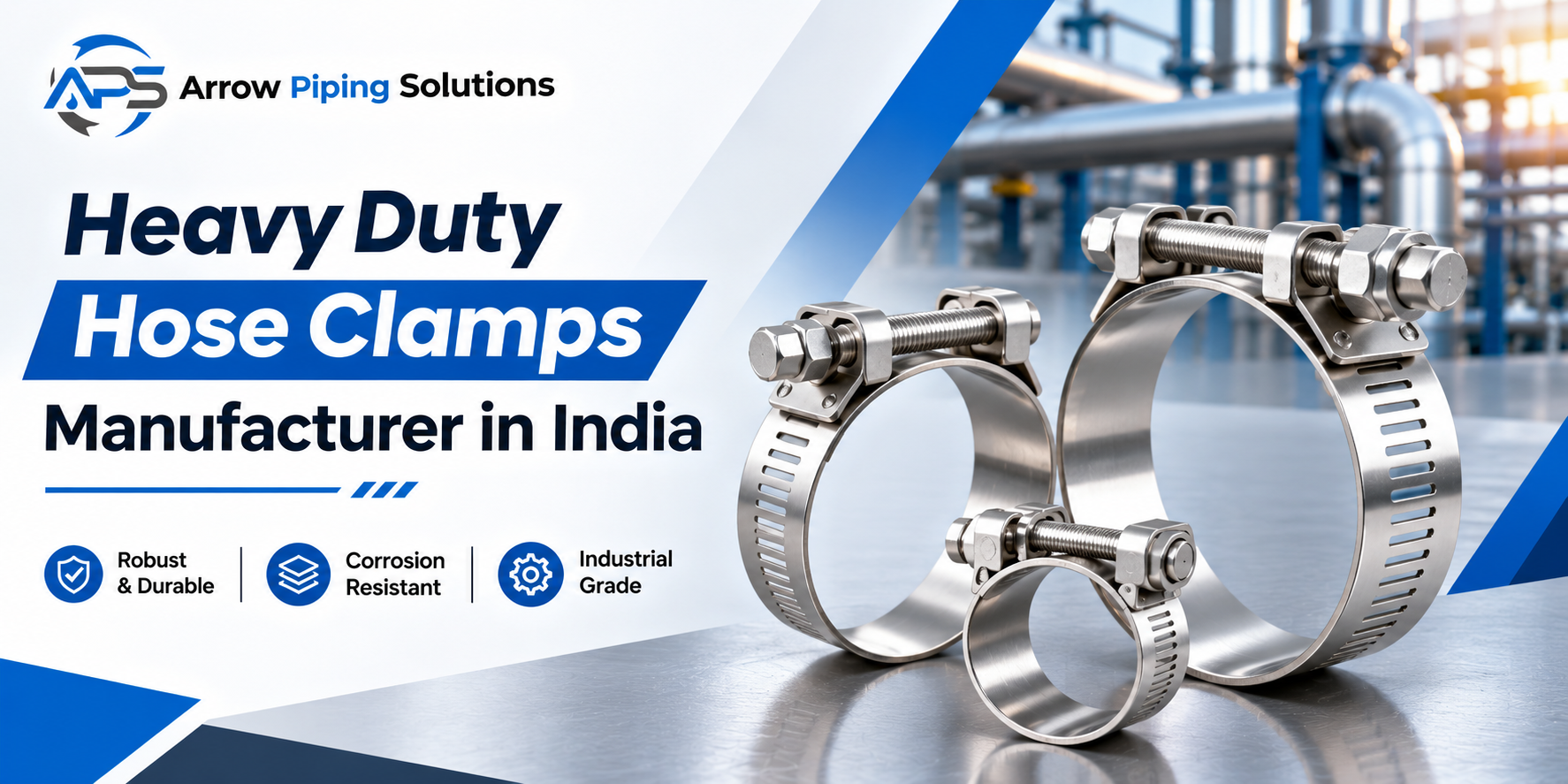
A heavy duty clamp should be selected against the installed hose outside diameter, fitting design, material exposure and tightening instructions. Replace this image path with an authentic matching clamp photograph before publishing.
Looking for a Heavy Duty Hose Clamps Manufacturer in India? Buyers often begin with a size and a quantity. That is a start, but it leaves out what matters at installation: the hose's outside diameter once fitted, the clamp's adjustment range, and whether its bolt, bridge and band suit the environment.
This guide from Arrow Piping covers the questions worth settling before placing an order. It also separates technical selection from supplier claims: manufacturing origin, available designs, material grades and inspection documents should be confirmed against the actual quotation, not assumed from a webpage.
1. What Is a Heavy Duty Hose Clamp?
Quick answer: A heavy duty hose clamp is a reinforced mechanical band assembly that tightens around a hose to help retain it on a compatible connection. T-bolt and bridge-style bolt clamps are common examples. The clamp is one part of the connection, not a substitute for a correctly designed hose and fitting.
A wider band or larger bolt may look stronger, but neither feature tells you the allowable working pressure of the assembled line. Hose reinforcement, fitting profile, temperature, vibration and correct tightening all affect the result.
2. Hose Clamp Types and Relevant Standards
The first decision is the clamp mechanism. A bolt clamp and a worm-drive clamp do not operate in the same way. Where a project references a DIN standard, confirm the exact part, edition and product form; not every item sold as a T-bolt clamp is automatically certified to that standard.
| Type / Reference | What It Describes | Buyer Check |
|---|---|---|
| Heavy duty T-bolt clamp | Reinforced band closed using a T-bolt/nut arrangement; designs may include a bridge. | Ask for the maker's drawing, diameter range, band width, material and torque guidance. |
| Bridge-style bolt clamp | Bolt-tightened clamp with a bridge across the gap for more continuous band support. | Check bridge fit, bolt clearance and suitability for hose wall and fitting. |
| DIN 3017-3 | Hose clamps, Part 3: bolt clamps, shapes C1 and C2. | Claim compliance only when it is documented for the offered model and edition. |
| DIN 3017-1 | Hose clamps, Part 1: worm gear drive clamps, shapes A and B. | Do not describe a T-bolt clamp as worm-drive compliant without basis. |
| Project / assembly specification | Hose and fitting requirements, approved joining method, installation and inspection. | Use the complete assembly specification rather than a clamp catalogue alone. |
3. Heavy Duty T-Bolt vs Worm-Drive Hose Clamps
Quick comparison: A T-bolt clamp tightens using a bolt-and-nut arrangement, while a worm-drive clamp uses a rotating screw that engages the band. The best choice depends on the required range, hose stiffness, installation access and the connection design—not the words “heavy duty” on a product listing.
| Selection Point | T-Bolt / Bolt-Type Clamp | Worm-Drive Clamp |
|---|---|---|
| Closure | Bolt/nut and reinforced band or bridge assembly | Screw engages perforated or embossed band |
| Common consideration | Demanding hose connections and specific large-diameter assemblies | General-purpose hose connections within rated limits |
| Fit | Choose the stated installed-diameter adjustment range | Choose its stated band and adjustment range |
| Interchangeability | Requires hose/fitting and installer approval | Not an automatic substitute for a specified bolt clamp |
4. Materials and Corrosion Resistance: What Does W4 or W5 Mean?
Stainless steel hose clamps are often described using W-series material groups. In common manufacturer catalogues, W4 broadly refers to stainless 304-type construction and W5 to stainless 316-type construction; exact component materials still depend on the specified product. Check the band and every fastener, trunnion and bridge.
| Material / Feature | Typical Selection Context | Practical Note |
|---|---|---|
| Zinc-plated carbon steel | Controlled indoor or less corrosive service where accepted | Check coating, exposure and maintenance plan. |
| Stainless steel 304 / W4-type | Many general industrial settings requiring corrosion resistance | Confirm the grade of bolt, nut and bridge as well as band. |
| Stainless steel 316 / W5-type | More demanding corrosion environments where 316 is appropriate | Not immune to crevice corrosion or all chloride conditions. |
| Band width and thickness | Selected for the hose and model geometry | Wider does not automatically mean better sealing. |
| Edge finish and bridge design | Protection of the hose surface and band-gap support | Check for burrs or sharp edges that can cut the cover. |
| Tightening torque | Depends on actual maker, model, size and assembly | Do not apply a generic torque value to every clamp. |
Material classifications and clamp geometries vary by catalogue. Require model-specific documentation if your purchase order calls for W4, W5, 304 or 316.
5. Common Heavy Duty Hose Clamp Designs
| Clamp Form | Where It May Be Considered | What to Specify |
|---|---|---|
| Single T-bolt clamp | Reinforced hose ends using an approved T-bolt-style connection. | Working diameter, band width, bolt type, grade and installation instructions. |
| Bridge / supra-style bolt clamp | Industrial hose connections needing a supported band-gap design. | Bridge geometry, size range, bolt material and model drawing. |
| Double-bolt hose clamp | Selected large or thick-wall hose assemblies where design permits. | Installed diameter, two-bolt tightening sequence and clearance. |
| Constant-tension clamp | Systems with thermal cycling where a suitable constant-tension design is specified. | Temperature range, spring mechanism and validated assembly requirements. |
| Custom-width / size clamp | Non-standard hose or fitting geometry, subject to feasibility. | Dimensioned sketch, hose data, quantity and approval criteria. |
These are industry design categories, not a statement that every pattern or size is made or stocked by Arrow Piping. Confirm the actual offered product and source.
6. Hose Clamp Sizes, Band Width and the Installed Diameter
Size rule: Measure around the hose after it has been pushed onto its actual fitting. The hose's nominal internal diameter is not the clamping diameter. Hoses with the same nominal bore may have different outside diameters, especially if their reinforcement or wall thickness differs.
| RFQ Field | Example Wording (Illustrative) | Why It Matters |
|---|---|---|
| Clamp type | Single T-bolt, bridge-style | Identifies the fastening design. |
| Installed hose OD | Measured on the fitting; provide measurement in mm | Prevents wrong clamp range selection. |
| Clamp working range | Maker's min–max diameter covering installed OD | Preserves adjustment room rather than bottoming out. |
| Band width / thickness | Per approved drawing or hose assembly requirement | Affects contact and fit around the hose. |
| Material | 304 or 316 stainless; specify all components | Clarifies corrosion resistance and price basis. |
| Quantity / records | Item-wise quantities; drawing and inspection needs | Makes different offers comparable. |
These entries show how to describe an enquiry; they are not Arrow Piping stock dimensions or validated working ranges. Ask for a datasheet for the offered model and check that the clamp can be positioned correctly behind the fitting's bead or stop where the fitting design requires it.
7. Inspection and Installation Checks
In practice, one slipped connection can come from something as ordinary as a clamp seated partly over the fitting bead, or a bolt tightened until the band deforms. A simple installation checklist catches issues a material certificate cannot.
| Inspection Point | Useful Buyer / Installer Question | Common Mistake |
|---|---|---|
| Clamp identification | Does the supplied type and working range match the order? | Using visually similar but different clamp models. |
| Band and edges | Any sharp edge, crack, bend, burr or coating damage? | Installing a damaged band against the hose cover. |
| Bolts and bridges | Are the threads clean and bridge/trunnions seated correctly? | Misalignment or thread galling during tightening. |
| Fitted position | Is the clamp positioned as required by hose/fitting maker? | Clamping over the wrong portion of the fitting. |
| Torque procedure | What does the exact clamp and hose assembly instruction require? | Using the maximum or a remembered torque blindly. |
| Assembly verification | What leak, pressure or retention checks does this service need? | Assuming a heavy duty clamp guarantees a seal. |
8. Where Are Heavy Duty Hose Clamps Used?
a) Industrial Water and Utility Hoses
Used where flexible hoses connect to suitable barbed or beaded fittings. Match clamp design to the hose wall, vibration and pressure conditions, especially near pumps.
b) Agricultural Irrigation and Pumping
Temporary and permanent hose assemblies may see dirt, weather and repeated handling. Material choice, installation access and inspection intervals often matter as much as initial cost.
c) Construction, Mining and Dewatering
Abrasive handling and vibration can stress hose connections. The clamp must be selected as part of an approved hose/fitting assembly; do not infer pressure suitability from appearance alone.
d) Automotive, Machinery and Process Utilities
Coolant, air and other utility lines may use different clamp geometries. Thermal cycling can change hose compression, so the appropriate clamp design and reinspection procedure should be established for the specific system.
9. Common Heavy Duty Hose Clamp Buying Mistakes
Quick Buyer Checklist
- Nominal-size ordering: Selecting by hose bore instead of measured outside diameter on the fitting.
- Wrong mechanism: Substituting a worm-drive clamp for a specified T-bolt or bridge-type clamp.
- Mixed-metal assumption: Ordering an “SS 316 clamp” without checking the bolt, bridge and nut grades.
- Torque guesswork: Using one tightening value for every clamp size or brand.
- Band position: Installing over a bead, taper or unsupported area contrary to fitting instructions.
- Pressure confusion: Treating the clamp's strength as a rated pressure for the entire hose assembly.
- No documented range: Accepting a diameter label with no maker drawing or tolerance detail.
10. Heavy Duty Hose Clamp Price and Delivery Factors
Rates generally vary by band and fastener material, diameter range, band width, design complexity, finish, quantity, inspection requirements and delivery location. A 304 clamp and a 316 clamp can look almost identical in a photo. Compare offers using the same component-grade breakdown and model specification.
Practical tip: If your enquiry contains several hose sizes, list the installed OD and quantities on separate lines. A supplier should not have to guess whether “50 mm hose” means the bore, a measured outside diameter or a clamp nominal size.
For export or project supply, add packaging, inspection, destination and agreed Incoterms to the RFQ. Confirm what evidence will accompany the goods before approving the order.
11. How to Prepare a Heavy Duty Hose Clamp Enquiry
Share the hose and fitting type, measured installed hose OD, required clamp mechanism, working diameter range, band width, material grades for every component, temperature/exposure, quantity and delivery location. If the connection is safety-critical, include the project-approved assembly drawing and testing requirements.
Need a heavy duty hose clamp quotation? Send your requirements to Arrow Piping with the hose/fitting details and required documentation. Request written confirmation of the actual clamp model, manufacturing source and supply scope.
12. Why Contact Arrow Piping for Industrial Hose Clamp Enquiries?
Arrow Piping is the enquiry contact for this guide. An item-wise requirement makes technical and commercial replies more useful: it helps separate the clamp's adjustment range from the hose's nominal size and clarifies what the buyer expects to receive. Confirm actual availability, origin, specifications, inspection scope and lead time for the offered batch.
Sticky Q&A: Quick Answers for Heavy Duty Hose Clamp Buyers
Eight direct answers to common selection, material and ordering questions.
Q1. What is a heavy duty hose clamp?
A heavy duty hose clamp is a reinforced band-and-fastener assembly used to retain a hose on a compatible fitting. T-bolt and bridge-style bolt clamps are common designs. The correct clamp depends on hose construction, installed diameter, fitting geometry and service conditions.
Q2. How do I choose the correct heavy duty hose clamp size?
Measure the outside diameter of the hose after it is placed on the actual fitting. Choose a clamp whose specified working diameter range covers that installed diameter with adjustment margin; nominal hose bore alone is not enough.
Q3. What is the difference between a T-bolt clamp and a worm-drive clamp?
A T-bolt clamp uses a bolt-and-nut mechanism with a robust band, often selected for demanding large-diameter assemblies. A worm-drive clamp uses a screw engaging band slots or embossing. Neither is automatically suitable for every pressure or hose type.
Q4. Should I choose SS 304 or SS 316 hose clamps?
SS 304 is often considered for general industrial corrosion resistance. SS 316 may be preferred where chloride exposure or a more aggressive environment justifies it. Confirm the grade of the band, bolt, bridge and other components, not just the band.
Q5. What tightening torque should be used for a heavy duty hose clamp?
Use the torque specified for the exact clamp model and size by its manufacturer and the hose assembly instructions. There is no universal safe torque for all heavy duty clamps; excessive torque can damage the band, fastener or hose.
Q6. Are heavy duty hose clamps suitable for high-pressure hoses?
Some are used in demanding hose assemblies, but a heavy-duty label is not a pressure rating. Pressure capability must be established for the complete hose, fitting, clamp and installation under the relevant design and testing requirements.
Q7. What information is required for a bulk hose clamp quotation?
Provide clamp type, installed hose outside diameter or required range, band width, material grade for all components, quantity, hose and fitting details, operating environment, required documentation and delivery destination.
Q8. How can buyers inspect heavy duty hose clamps before installation?
Check markings and material records where specified, band edges, bridge alignment, bolt threads, diameter range, finish and visible defects. After fitting, confirm the clamp position and tightening process, and perform the assembly checks required for the application.
Field Note for the Arrow Piping Technical Team
Suggested technical-team wording for review and approval: “Before comparing heavy duty hose clamp prices, check the installed hose diameter, band and bolt material, and the exact tightening instructions. Two clamps that look the same in a photo may not fit or behave the same way on the hose.”
This is proposed editorial wording for Arrow Piping to approve; it is not presented as an authenticated employee quote.
Conclusion: Select for the Actual Hose Assembly
When evaluating a Heavy Duty Hose Clamps Manufacturer in India, the useful question is not simply which clamp looks strongest. Get the fitted diameter, clamp design, full material specification, tightening instructions and assembly checks right. Those details reduce incorrect purchases and prevent avoidable installation problems.
Email inquiry@arrowpiping.co.in or visit the Arrow Piping contact page to send your item list, hose/fitting drawing and project requirements.