Inconel 718 Fasteners Exporter in India
Practical sourcing and technical guide to Inconel 718 / UNS N07718 bolts, studs, nuts, screws and custom fasteners supplied for project-specific export requirements by Arrow Piping India
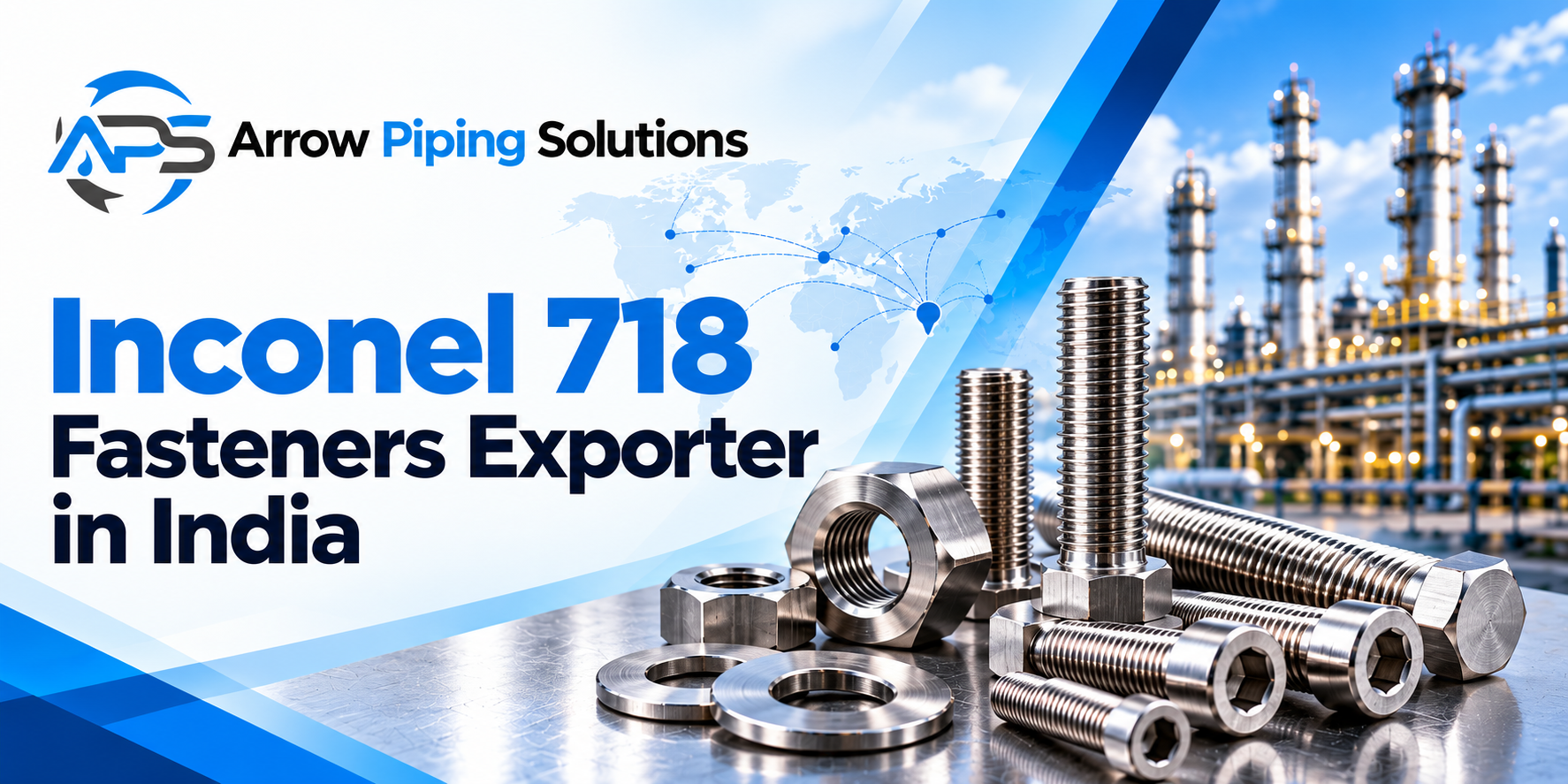
Inconel 718 / UNS N07718 fasteners for high-strength, elevated-temperature and engineered fastening requirements
If you are searching for an Inconel 718 Fasteners Exporter in India, the useful question is not simply “Do you have 718 bolts?” A serious RFQ usually needs the exact fastener type, governing material standard, diameter, length, thread series, heat-treatment condition, dimensional requirement, quantity and inspection scope.
Arrow Piping, Mumbai, handles export enquiries for Inconel 718 / UNS N07718 fasteners used in demanding engineered assemblies. Requirements may include bolts, stud bolts, threaded studs, socket head cap screws, nuts, washers and drawing-based fasteners. The correct specification should come from the buyer’s approved drawing, equipment standard or project material requirement rather than being guessed from the alloy name alone.
Quick engineer's note
“With Alloy 718 fasteners, the material name is only the start. We ask buyers to confirm the governing standard, heat-treatment condition, thread form, dimensions and inspection requirements before pricing.” — Arrow Piping technical team
That small amount of detail prevents a common problem: receiving a fastener made from the right alloy but to the wrong thread, strength condition, tolerance or documentation requirement.
1. What Are Inconel 718 Fasteners?
Inconel 718 fasteners are fastening components made from Alloy 718, identified as UNS N07718 and W.Nr. 2.4668. Alloy 718 is a precipitation-hardenable nickel-chromium material containing iron, niobium, molybdenum, titanium and aluminum. It is known for combining high strength with useful corrosion resistance and good performance across a wide temperature range.
The alloy is used for fasteners because joint integrity can depend on more than basic tensile strength. Elevated temperature, fatigue, vibration, thermal cycling, corrosion exposure, preload retention and inspection requirements can all influence fastener selection. In practical buying terms, “718” is the material identity; it does not by itself define the finished bolt, stud or nut.
2. Inconel 718 Standards & Material Identification
| Specification / Identification | Typical Requirement |
|---|---|
| Alloy / UNS | Inconel 718 / Alloy 718, UNS N07718 |
| Werkstoff Number | W.Nr. 2.4668 |
| High-Temperature Bolting | ASTM A1014/A1014M for precipitation-hardening bolting and bolting components in UNS N07718 |
| Fastener Specification | ASTM F2281 may apply to nickel-alloy bolts, hex cap screws and studs for heat/high-temperature applications |
| Raw Material Reference | ASTM B637 is commonly associated with precipitation-hardened nickel-alloy bar, forgings and forging stock; use only when required by the purchase specification |
| Thread / Dimensions | Unified, metric or drawing-specific threads and dimensional standards as stated in the purchase order |
| Documentation | Material and test documentation should match the governing product standard and customer inspection requirements |
3. Chemical Composition of Inconel 718 / UNS N07718
The ranges below are widely used to identify Alloy 718 chemistry. For procurement, always compare the actual heat analysis on the material certificate with the exact standard and revision stated on the purchase order.
| Chemical Element | Typical Alloy 718 Range (%) | Why It Matters |
|---|---|---|
| Nickel + Cobalt | 50.00 – 55.00 | Forms the main nickel-rich matrix and supports corrosion and high-temperature performance. |
| Chromium (Cr) | 17.00 – 21.00 | Contributes to oxidation and corrosion resistance. |
| Iron (Fe) | Balance | Major constituent of the alloy system alongside nickel and chromium. |
| Niobium + Tantalum (Nb + Ta) | 4.75 – 5.50 | Important to the precipitation-hardening response that gives Alloy 718 its strength. |
| Molybdenum (Mo) | 2.80 – 3.30 | Supports strength and corrosion performance in the nickel-chromium matrix. |
| Titanium (Ti) | 0.65 – 1.15 | Participates in age-hardening reactions and affects final material properties. |
| Aluminum (Al) | 0.20 – 0.80 | Works with other hardening elements during precipitation heat treatment. |
4. ASTM A1014 vs ASTM F2281 — What Buyers Should Check
This is where many enquiries become vague. ASTM A1014/A1014M is specifically written for precipitation-hardening bolting in UNS N07718 for high-temperature service. ASTM F2281 is broader and covers stainless steel and nickel-alloy bolts, hex cap screws and studs intended for heat and high-temperature applications. They are not just two names for the same purchase requirement.
| Check Point | ASTM A1014/A1014M | ASTM F2281 |
|---|---|---|
| Material Focus | Specifically covers precipitation-hardening bolting in UNS N07718 | Covers multiple stainless and nickel-alloy fastener grades, including Alloy 718 |
| Product Scope | Bolting material and bolting components for high-temperature service | Bolts, hex cap screws and studs for heat/high-temperature applications |
| Buyer Action | State the required edition, dimensions, condition and supplementary requirements | State alloy grade, fastener type, size, thread, condition and any optional testing |
Sticky Q&A: “Can I just write Inconel 718 bolt on my enquiry?”
Short answer: You can, but it is not enough for a technical quotation. At minimum, add the governing standard, bolt/stud type, diameter, length, thread series and pitch, quantity, heat-treatment condition if specified, testing and certification.
Better RFQ example: “UNS N07718 / Alloy 718 stud bolt, ASTM A1014/A1014M, 3/4 in diameter, 10 in length, 10 UNC thread, quantity 40, certification and marking as per PO.” Then add any drawing, coating, nut, washer, inspection or packing requirement that applies.
5. Range of Inconel 718 Fasteners Exported by Arrow Piping
Arrow Piping can review standard and drawing-based Alloy 718 fastener requirements for project, maintenance, OEM and replacement enquiries. Final supply depends on the exact specification, size, quantity and testing scope.
| Fastener Type | Typical Configuration | Common Use |
|---|---|---|
| Inconel 718 Hex Bolts | Hex head, partial or full thread, unified or metric thread | High-strength mechanical joints and equipment assemblies |
| Inconel 718 Stud Bolts | Continuous or double-end thread, project-specific length and thread engagement | Flanged joints, pressure equipment and high-temperature assemblies where specified |
| Inconel 718 Nuts | Hex, heavy hex or drawing-specific geometry | Mating components for compatible bolting systems; nut specification must be confirmed separately |
| Inconel 718 Socket Head Cap Screws | Internal hex drive, standard or drawing-based dimensions | Compact assemblies where head clearance and high clamping load are important |
| Inconel 718 Washers | Plain or special washers to applicable dimensions | Load distribution and assembly requirements when specified by the joint design |
| Custom / Drawing Fasteners | Special heads, shoulders, reduced shanks, non-standard lengths or threads | OEM, turbine, aerospace, process equipment and engineered replacement applications |
6. Sizes, Threads & Dimensional Details
Inconel 718 fasteners can be ordered in inch or metric formats depending on the equipment and governing standard. Common thread families include UNC, UNF and metric threads, but the exact diameter, pitch, class of fit, thread length, head dimensions and under-head length should be stated on the drawing or purchase order.
One practical point buyers sometimes miss: nominal diameter and overall length are not enough for custom fasteners. On studs, confirm whether length includes threaded ends and how thread engagement is measured. On bolts, confirm under-head length, grip length and whether the thread must stop before the shear plane. Small wording differences here can create expensive rework.
7. Where Are Inconel 718 Fasteners Used?
a) Gas Turbines & High-Temperature Machinery
Alloy 718 is used in gas-turbine and high-temperature machinery components because the alloy retains useful strength at elevated temperatures. Fasteners in these assemblies still need the correct heat treatment, thread condition, preload and inspection requirements defined by the equipment specification.
b) Aerospace & Propulsion Systems
Alloy 718 has a long history in aerospace, rocket and propulsion hardware. For aerospace fasteners, the governing aerospace material and part specification is critical; a generic industrial Alloy 718 certificate should not be treated as automatically equivalent to an aerospace-qualified fastener requirement.
c) Oil, Gas, Petrochemical & Process Equipment
Inconel 718 fasteners may be selected for valves, pumps, pressure equipment, offshore or process assemblies where the approved material specification calls for UNS N07718. Corrosion environment, temperature, preload and any sour-service restrictions should be checked by the project engineer.
d) Cryogenic, Instrumentation & Engineered Assemblies
Alloy 718 is also used in cryogenic tankage, instrumentation parts and specialised mechanical assemblies. In replacement jobs, matching the original drawing, thread form, heat-treatment condition and marking can be more important than simply matching the visible bolt size.
8. Testing, Inspection & Traceability
For export orders, agree the inspection and documentation scope before manufacturing or dispatch. Depending on the governing standard and purchase order, the supply package may include:
Typical QA/QC Requirements
- Material Test Certificate: Heat-wise chemistry and applicable mechanical test results according to the ordered specification.
- Mechanical Testing: Tensile, hardness, stress-rupture or other tests where required by ASTM A1014/A1014M or the customer specification.
- PMI: Positive Material Identification when specified to verify alloy identity before dispatch.
- Dimensional Inspection: Diameter, length, head dimensions, thread pitch, thread length and drawing tolerances.
- Thread Inspection: Gauging and verification of the specified thread series, pitch and class of fit.
- NDT / Additional Tests: Any supplementary examination should be stated in the purchase order rather than assumed.
- Traceability: Heat number, lot identification and product marking should remain linked to the supplied test documentation.
9. Sticky Q&A — Questions Buyers Actually Ask
Q: Is Inconel 718 the same as Inconel 625?
A: No. Alloy 718 is precipitation hardenable and is often selected where high strength and elevated-temperature performance are important. Alloy 625 has different chemistry and a different strengthening mechanism and is widely used for corrosion resistance. Do not substitute one for the other without engineering approval.
Q: Which ASTM standard should I specify for Inconel 718 bolts or studs?
A: ASTM A1014/A1014M specifically covers UNS N07718 precipitation-hardening bolting for high-temperature service. ASTM F2281 can also apply to nickel-alloy bolts, hex cap screws and studs for heat/high-temperature applications. Use the standard required by the project, equipment drawing or approved material specification.
Q: Can the same certificate be used for the bolt and nut?
A: Not automatically. The bolt/stud and nut can have different product specifications, dimensions and mechanical requirements. Ask for traceable certification for each ordered component and check that the nut grade and condition are compatible with the joint design.
Q: Should Alloy 718 threads be rolled or cut?
A: Follow the governing standard, drawing or purchase specification. For critical fasteners, write the thread-forming requirement directly into the RFQ instead of assuming the supplier will choose the same method used on the original part.
Q: Can Inconel 718 fasteners gall during assembly?
A: Nickel-alloy threaded joints can be sensitive to galling depending on surface condition, mating material, speed, load and lubrication. Use the project-approved lubricant or coating system and the specified torque/tension procedure; do not apply a generic anti-seize product without checking compatibility.
Q: Are standard commercial dimensions enough for a replacement fastener?
A: Not always. Check head style, under-head length, grip, shank diameter, thread length, radius, run-out and any reduced section against the original drawing. A bolt can have the correct diameter and still be wrong for the assembly.
Q: What information should I send for an export quotation?
A: Send the material/UNS number, governing standard, fastener type, diameter, length, thread series and pitch, quantity, heat-treatment condition if specified, dimensional standard or drawing, testing, certification, marking, packing and delivery destination.
10. Inconel 718 vs Inconel 625 vs A286 — A Simple Selection View
These materials are sometimes grouped together because all can appear in demanding fastener applications, but they are not interchangeable. Alloy 718 is a precipitation-hardenable nickel alloy selected for a combination of strength and elevated-temperature capability. Alloy 625 is a nickel-chromium-molybdenum alloy commonly chosen for corrosion resistance. A286 is an iron-nickel-chromium precipitation-hardened alloy used in high-strength and elevated-temperature bolting applications.
Expert sourcing takeaway
Do not buy a fastener by alloy nickname alone. Match the material designation, heat-treatment condition, product standard, thread, dimensions, mating nut, service temperature and inspection plan to the actual joint requirement.
11. What Affects Inconel 718 Fastener Price?
- Fastener Geometry: Head style, shank shape, shoulders, reduced sections and non-standard machining affect cycle time and material usage.
- Diameter & Length: Larger or unusually long bolts and studs require more Alloy 718 stock and may need additional processing.
- Thread Requirement: Fine threads, special pitches, tight tolerances or specified thread-rolling requirements can change manufacturing cost.
- Heat-Treatment Condition: The ordered material/fastener condition and applicable standard influence processing and verification.
- Testing: Mechanical testing, PMI, NDT, dimensional reports or customer-specific inspection plans add scope.
- Quantity: Very small lots can carry higher setup and inspection cost per piece than repeat production quantities.
- Export Packing & Freight: Destination, weight, packing method and shipping mode affect landed cost.
Why Contact Arrow Piping for Inconel 718 Fastener Export Enquiries?
For an Inconel 718 Fasteners Exporter in India, the useful part of the conversation is getting the RFQ technically complete before the order moves. Arrow Piping can review buyer requirements against the stated material, fastener type, dimensions, testing and export documentation scope.
- Multiple Fastener Forms: Enquiries can include bolts, stud bolts, threaded studs, nuts, socket head cap screws, washers and drawing-based parts.
- Specification-Based Review: Requirements are checked against the standard, dimensions, threads, heat-treatment notes and customer drawing provided with the RFQ.
- Documentation Planning: Material/test certification, marking, inspection and packing requirements can be defined before dispatch.
- Traceability Focus: Heat/lot identification should remain linked to the ordered documentation where traceability is required.
- Export Coordination: Packing and shipment details can be aligned to the destination and purchase-order scope.
Need Inconel 718 fasteners for an export requirement? Request a Quote from Arrow Piping. Send the material/UNS number, standard, fastener type, size, length, thread, quantity, drawing if available, inspection requirements and delivery location.
12. Export Ordering Checklist
Before sending an enquiry, check these details once: UNS N07718 / Alloy 718 material identity, governing ASTM/ASME/AMS or customer specification, fastener type, diameter and length, thread series and pitch, quantity, required heat-treatment condition, drawing or dimensional standard, mating nut/washer requirement, testing, certification, marking, packing and final delivery destination. A clear RFQ normally gets a clearer quotation.
13. Common Buyer Mistakes to Avoid
Do not copy “Inconel 718 bolt” from an old BOM without checking the current drawing. Do not assume all 718 material certificates represent the same finished-fastener condition. Do not mix metric and inch thread descriptions in one line item. Do not leave nut grade, thread fit, coating/lubricant or inspection notes to guesswork. And for replacement parts, measure more than the visible diameter—grip length, thread run-out and head geometry are often the details that decide whether the part actually fits.
Conclusion
Choosing an Inconel 718 Fasteners Exporter in India is easier when the enquiry is treated as an engineering purchase rather than a material-name search. Alloy 718 / UNS N07718 offers a useful combination of strength, corrosion resistance and elevated-temperature capability, but the finished fastener still depends on the correct standard, condition, dimensions, thread, testing and traceability.
For quotations, send your requirement to inquiry@arrowpiping.co.in or review the broader range on our Fasteners Product Page. A drawing or clean BOM with the exact purchase requirements is the fastest starting point.